

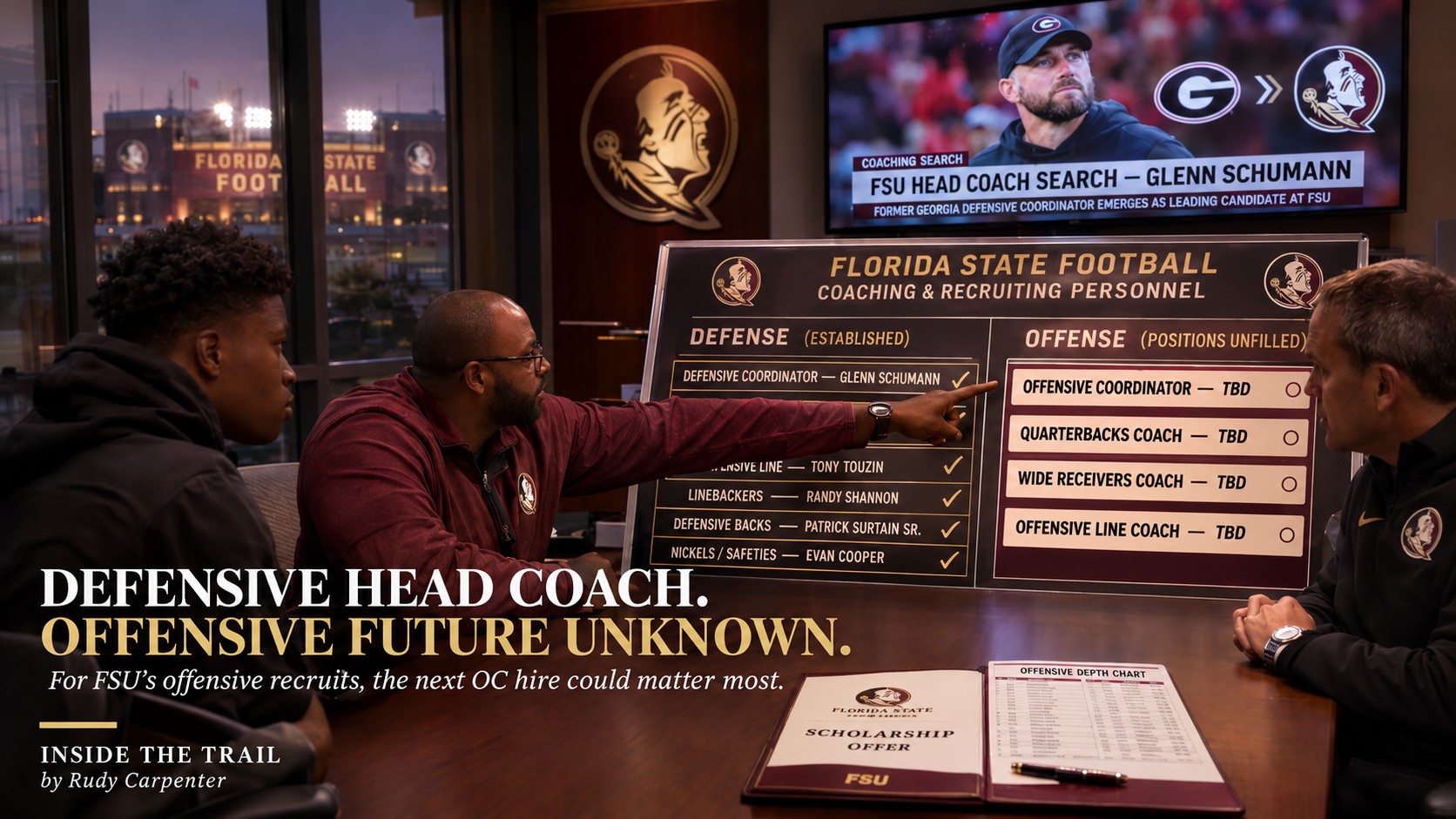
Georgia defensive coordinator Glenn Schumann emerged this week as the front-runner for the Florida State head coaching job. The coverage has focused on what his defensive background and Georgia pedigree mean for the Seminoles program. That is a reasonable frame. Schumann has spent eleven seasons in Athens, helped build one of the most consistently elite defenses in college football, and carries a recruiting network rooted in the Deep South. For Florida State's defensive identity, his hire would signal a clear direction.
For families whose athletes play offense, it signals something else entirely.
The hire families do not think about
A defensive coordinator who takes a head coaching job brings one thing fully assembled: his defensive staff. The offensive side of the football is a blank page. At Florida State, that means every offensive position is to be determined. The offensive coordinator, the quarterbacks coach, the wide receivers coach, the offensive line coach: none of those have been named. The person who would recruit, evaluate, and develop your athlete for the next three or four years does not exist yet.
That may sound obvious when you say it out loud. But a family with an offensive commitment at Florida State right now has spent the past several months building a relationship with a staff that is almost certainly going to be replaced. The relationship your athlete built with that position coach does not automatically transfer to whoever the new offensive coordinator eventually brings in.
What the first month inside the building looks like
The head coach hire takes the headlines. What follows over the next four to six weeks is quieter and, for most families with offensive players in the class, more consequential.
The new head coach needs to identify an offensive coordinator, and that search signals something important before the hire is even announced: what scheme the program is going to run. The scheme shapes which recruits fit and which ones do not. It also shapes which transfer portal players the staff will target in January, and in a revenue-share environment those portal acquisitions directly affect how many spots remain in the high school class.
The OC search rarely resolves in a week. Three to five weeks after the head coach hire is a more typical timeline. And the offensive coordinator often brings his own position coaches, or at minimum has strong input on who fills those roles. The person who will eventually coach your athlete's position may not be named until January or even February. For 2027 families committed on the offensive side, that is the real gap in what they know right now.
What families should be watching between now and January
I talk to position coaches every week, and the pattern after a defensive-to-offensive rebuild is consistent. The new offensive coordinator moves quickly once he is hired, but that outreach almost always carries an implicit re-evaluation. He wants to know if your athlete fits his system. His size requirements, his scheme demands, his evaluation priorities may be different from the staff that made the original offer. That is not a warning sign. It is what every family with an offensive commitment at a program in this kind of transition should expect and prepare for.
Florida State is the most visible version of this dynamic right now, but the same question applies any time a defensive coordinator steps into a head coaching job. The offensive staff build that follows is where the real recruiting story unfolds. Not the headline hire. What comes after it.
For families watching the FSU search: the news worth paying closest attention to is not who gets named head coach. It is who gets named offensive coordinator. That is the person who will decide what your athlete's future at that program actually looks like. So the question worth asking is: when that OC is announced, is your athlete's film current, does it reflect the system he runs, and do you have a way to get it in front of him quickly?