

What a general manager told ESPN
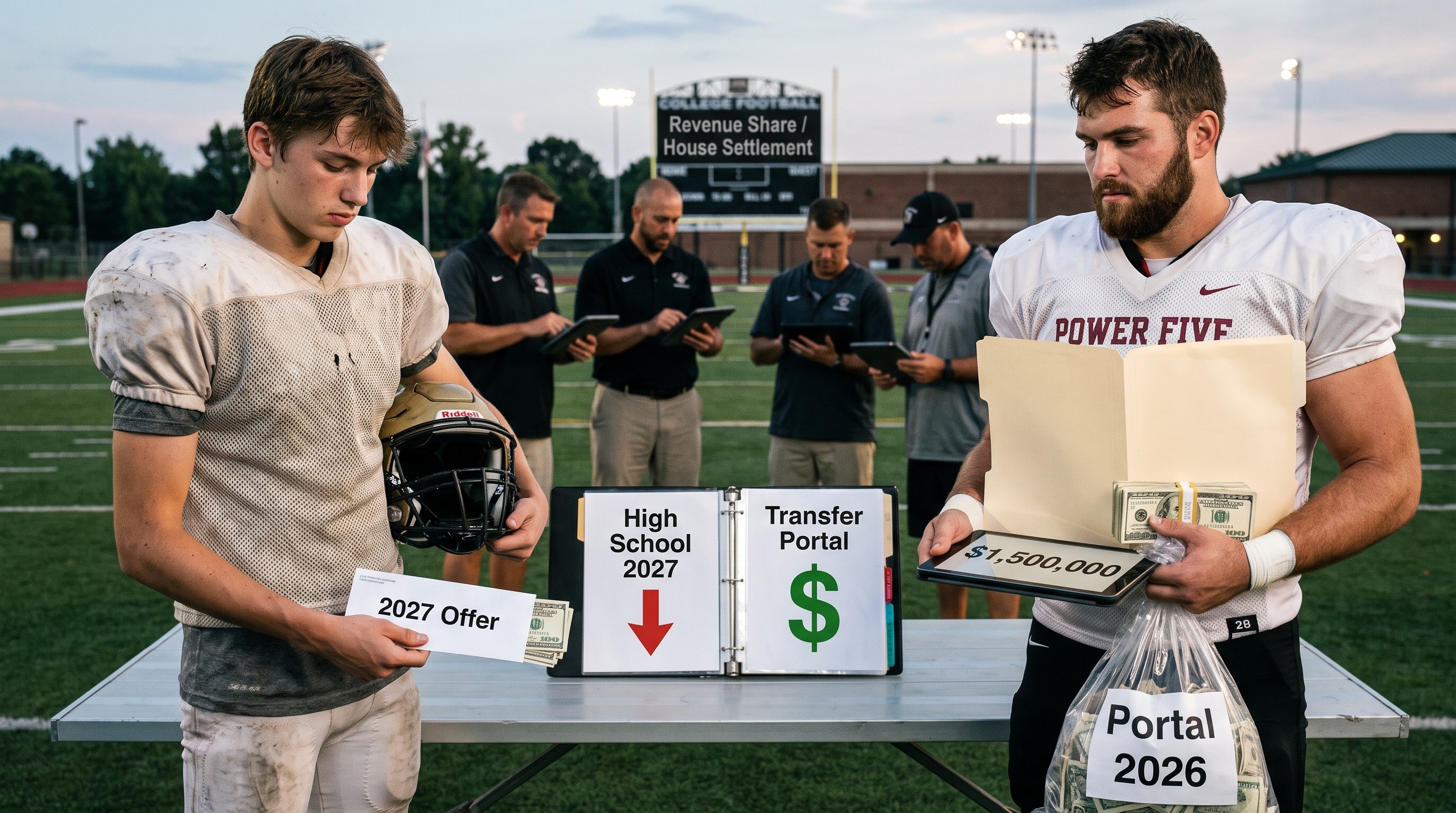
A Big Ten general manager described the market plainly in ESPN's reporting from this summer: "High school spending is going to get a lot lower" for the 2027 class. The observation reflects a structural shift that has accelerated since the House settlement created a single January transfer portal window and embedded revenue sharing into program budgets.
Programs that competed aggressively for high school talent in prior cycles are now routing more of their available roster spending toward experienced portal players. The mechanics are straightforward: with one portal window, there is no second chance to fill a roster gap until December. That scarcity has raised the competitive premium on proven contributors over development-timeline bets.
Where the money is going instead
ESPN's reporting on 2026 position costs shows quarterbacks ranging from $1 million to $3 million at the elite level, with edge rushers and offensive tackles commanding comparable packages. Most of that market reflects experienced players moving through the portal, not incoming freshmen.
Industry sources estimate that above-cap roster spending among the sport's most competitive programs has already cleared $40 million. The $20.5 million revenue-sharing baseline is increasingly a floor, not a ceiling.
The result is a bifurcated market. Top-100 high school prospects are still seeing substantial packages, some reaching seven figures in the 2027 class. Below that tier, the pool of dollars programs can allocate to high school development projects is narrowing as experienced players absorb more of the available budget.
What this means for families reading offers this fall
Two questions are worth separating clearly when a family evaluates an offer.
The first is what the dollar amount actually signals. In a market where programs are concentrating spending on immediate contributors, a modest high school package may reflect budget allocation decisions, not genuine interest level. The right question is not whether the number matches what was offered two cycles ago. It is whether the athlete is a real priority for that program.
The second is what a program's spending posture says about its patience for development. A staff routing most of its discretionary budget toward experienced portal players is making a choice about competitive timelines. Where a high school athlete fits within that calculus is a different question from what the offer document says.
The offer amount is one signal. Understanding why programs are structuring high school packages the way they are right now, in a market shifting this quickly, is the advisory conversation that gives families a clearer picture of what an offer actually represents.