

What the rule says, and how it is being stretched
NCAA rules are straightforward on unofficial visits: transportation, lodging, and meals are the family’s responsibility. The program cannot cover those costs.
In practice, that boundary has been eroded in two ways. The first involves illegal arrangements that have existed for years: cash payments routed through high school coaches, booster-funded travel with enough arm’s length to avoid attribution, hotel blocks organized through program-adjacent collectives. CBS Sports reporting documented those patterns across multiple Power Four programs, with accounts from anonymous general managers and program staff.
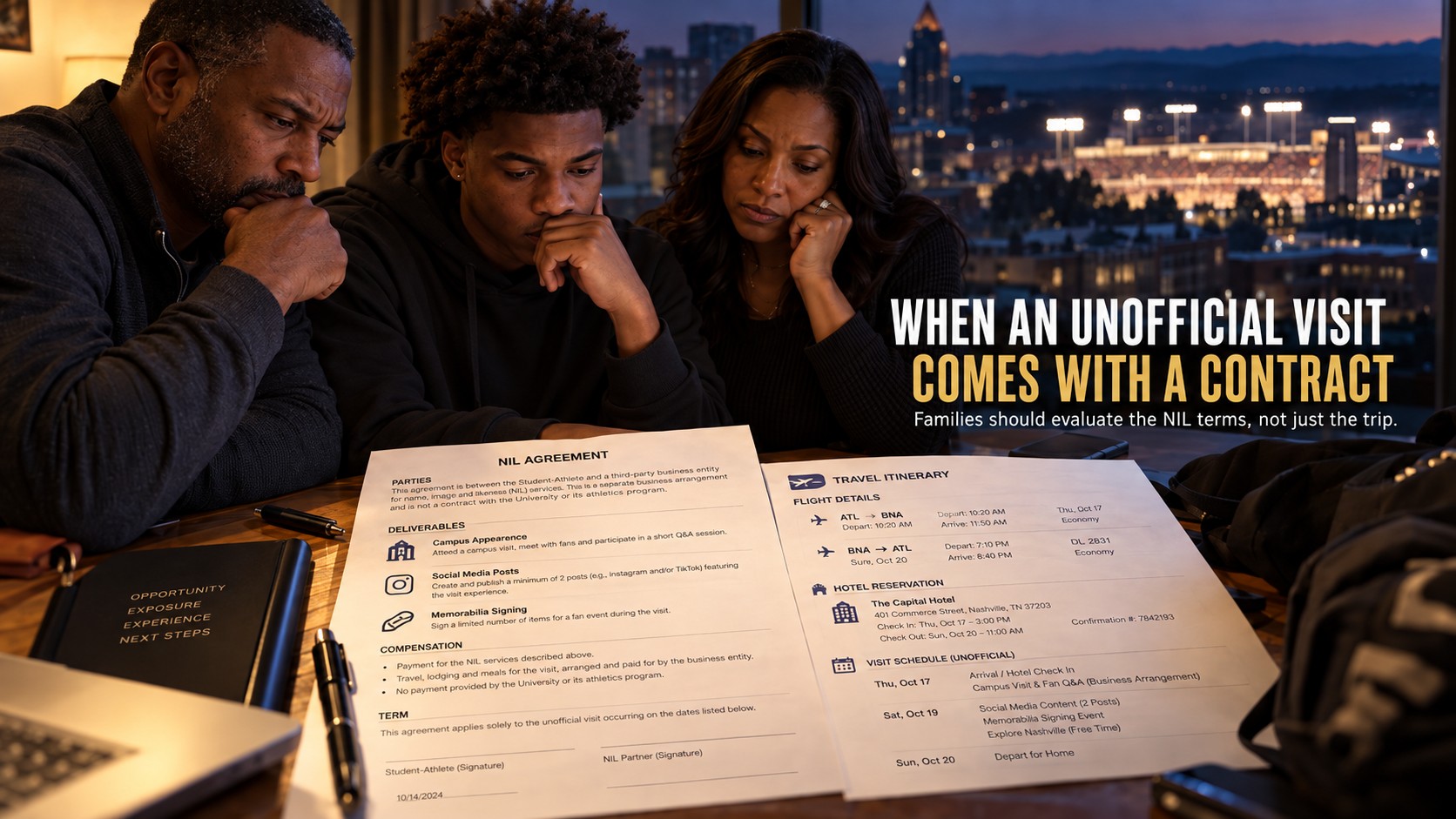
The second way is legal. Because high school NIL is permitted in 45 states, and because the College Sports Commission does not review those contracts until a player enrolls, programs can offer a recruit a NIL deal structured around a campus appearance, social media posts, and memorabilia signings, with a payment effectively covering what would otherwise be the family’s travel costs.
One documented example from that reporting: a high-profile 2026 commit received a $10,000 contract requiring a tailgate appearance, three Instagram posts, and 10 memorabilia signatures. The visit was funded. The contract was clean. The oversight was minimal.
The question for families
Families receiving a visit-tied NIL offer are being asked to make a business decision with almost no external guidance available.
The deal may be structured cleanly, fully disclosed, and entirely above board. It may also carry implied expectations about where the athlete is ultimately headed, market-value questions the CSC may revisit at enrollment, or disclosure requirements the family does not yet know exist.
Three questions to ask clearly before accepting anything:
- What deliverables are required and over what period. A tailgate appearance and three posts is a different commitment than a sustained brand relationship.
- Whether this will be documented, signed, and disclosed at enrollment. Informal arrangements carry more risk than written contracts. Any high school NIL deal must be disclosed to the institution upon enrollment.
- What the relationship looks like if the athlete signs elsewhere. That question rarely gets asked. The answer matters.
Why this is happening now
Programs recruiting nationally, particularly those chasing players outside their geographic base, face a structural problem. Unofficial visits are supposed to cost the family nothing, which means a family in Ohio deciding whether to visit a program in California faces a real friction the program cannot legally remove.
High school NIL contracts solve that problem legally for programs with the resources and the relationships to structure them. For programs without those resources, the CBS Sports reporting makes clear that the illegal options still exist alongside the cleaner ones.
The practical consequence for families: an unofficial visit invitation during fall recruiting is no longer necessarily a simple trip. It may come with a financial offer attached. That offer deserves the same scrutiny as any other part of the process.