

The number, not the noise
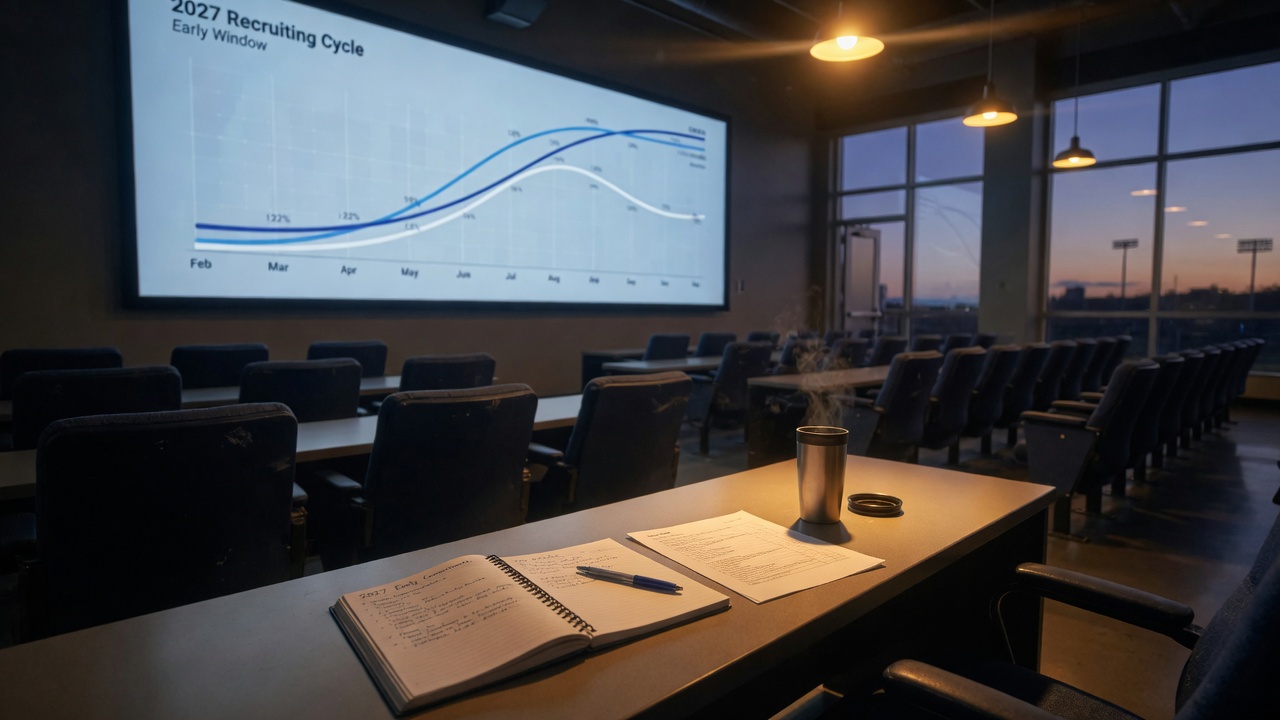
As of May 19, 2026, 165 of ESPN's top 300 recruits in the 2027 class are committed. That is 55 percent. On the same date one year earlier, the figure was 136, or 45.3 percent. Among the top 100, 58 prospects have already given a verbal pledge. Among ESPN's 21 five-star recruits in the class, only seven remain uncommitted.
The shift is not a small one. It is a roughly 10-point jump on the same date, in the same talent tier, year over year (per ESPN's recruiting reporting).
What is driving it
The driver is contractual, not emotional. Programs are putting revenue-share term sheets, and in some cases multi-year financial packages, in front of recruits before official visits begin. ESPN reports that at least five 2027 prospects are set to sign deals that will pay more than $1 million in their first college season. An Alabama general manager told ESPN that nearly every recruit committing in the spring is doing so with a term sheet already in hand.
This changes what an official visit is for. Under the older model, the visit was where a program closed. Under the current model, the closing has often already happened. The visit ratifies a financial agreement that was negotiated weeks earlier.
What the visit is actually evaluating now
Coaches are saying this directly. Alabama general manager Courtney Morgan told ESPN that for the recruits who commit this early, "most of those guys aren't going to go take a bunch of other visits from there." Georgia Tech head coach Brent Key told the same publication that the Sunday morning meeting on a visit weekend is now the financial alignment meeting. If a family and a program are not aligned on money by then, the rest of the weekend was largely cosmetic.
The implication for families is straightforward. The visit calendar still matters, but its purpose has shifted. The visit is now a fit check layered on top of an offer, not the moment the offer is built.
What a family should take from this
A family in the 2027 cycle has two things to watch.
First, the pace of the class is real, and it is asymmetric. The top of each position group is filling earlier than the rest. A family with a top-200 caliber athlete is now being evaluated against a board that fills earlier in the spring than it did a year ago. The implication is preparation, not pressure. Materials, evaluation video, transcripts, and a clear list of programs of interest are more useful in February and March of the junior year than they were two cycles ago.
Second, an early offer is not the same as the right offer. Term sheets arriving before a visit do not change what makes a program a good fit for an athlete academically, geographically, developmentally, or stylistically. Financial alignment matters, and it matters more now than it did two cycles ago. It is not the only alignment.
The right pace for a family in the 2027 cycle is not the fastest pace. It is the pace that lets the family read what is actually being offered, before signing.