

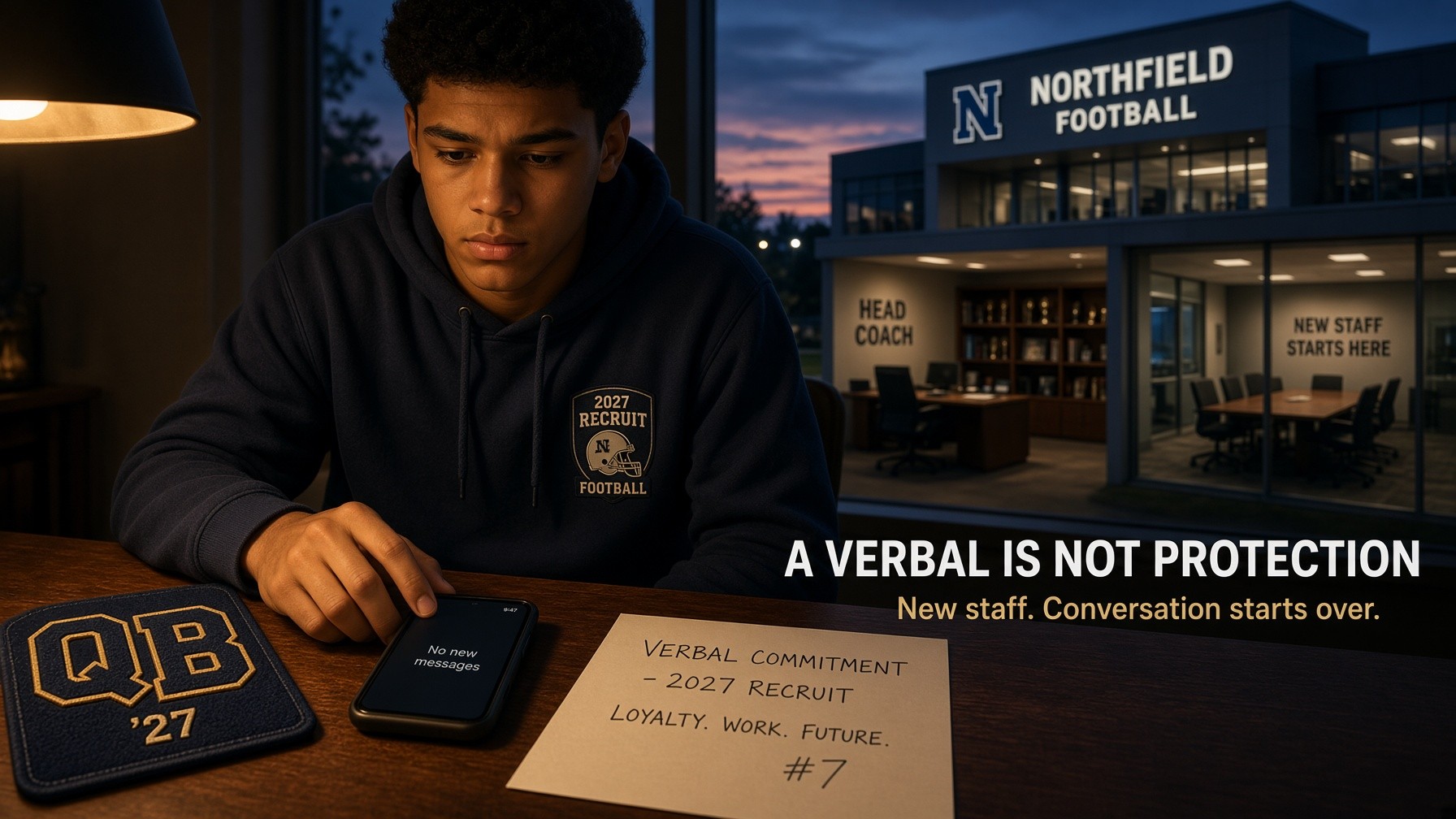
When a head coach is fired during the fall season, it typically takes less than 48 hours for decommitments to begin. At UCLA in the 2025 cycle, seven members of the 2026 recruiting class withdrew their verbal commitments within two days of the head coach's firing, according to ESPN's fall roster FAQ. That pattern has repeated itself each time a coaching staff turns over at a program with active verbal commitments in its class. The current fall carousel has already produced multiple head coaching changes at Power 4 programs, and more are likely before the 2027 early signing period opens in December.
Why a head coaching change is different
An offensive coordinator departure reshapes the scheme an athlete expects to enter. An athletic director change affects institutional stability. But a head coaching change resets the recruiting relationship itself. The verbal commitment was made to a specific coach, a specific staff, and a specific vision of how the athlete's development would unfold. None of those things are guaranteed to carry forward when a new staff arrives.
The incoming coach inherits the program. They do not inherit the commitments the previous staff built. A new staff evaluates every recruit in the class against their own positional needs, scheme preferences, and roster construction goals. Some commitments survive that process. Others do not. The distinction is made by the new staff, not by the family.
What a verbal commitment means when the staff changes
A verbal commitment is not a binding agreement. Before the early signing period opens in early December, there is very little in writing that obligates either the program or the athlete to follow through.
Revenue-sharing contracts cannot be formally signed before December 4. That means a verbal commitment made to a departing coach carries no contractual backing. When a new staff arrives, they can honor prior commitments, decline to honor them, or put the question on hold while they evaluate the incoming class on their own terms.
Many new staffs do honor prior commitments, particularly when those athletes fit the new scheme. But assuming that outcome without confirming it leaves a family without a clear plan when the answer is slower or less certain than expected.
What a committed family should do right now
A coaching change does not require an immediate decommitment. It requires a posture shift.
The right move is to initiate contact with the incoming staff early, confirm interest from both sides, and treat this as the beginning of a new recruiting conversation rather than the conclusion of an existing one. That includes updated film, a refreshed profile, and materials that reflect the current season. A new staff evaluating a commitment they did not recruit will look at current production, not prior relationships.
It also means being honest about fit. The original commitment was to a specific coach and a specific vision for the program. A new coaching staff may bring a different offensive philosophy, a different approach to development, or a different character of program altogether. The question worth asking is whether the athlete's fit holds with the new staff, not just whether a scholarship offer still stands.
The window between now and signing day
For committed 2027 athletes whose program has changed its head coach this fall, the early signing period opens December 4. That is less than three months from now.
A new staff that has not clearly confirmed a prior commitment by the time fall official visits begin is a staff that has not yet decided. That is information worth gathering early, not something to find out in November.
The families best positioned here are the ones with a clear process already in place: strong materials, honest fit evaluation, and an understanding that the commitment was the beginning of a relationship, not the end of one. When that relationship resets, the work is to rebuild it with the right people in the room.