What changed on May 29
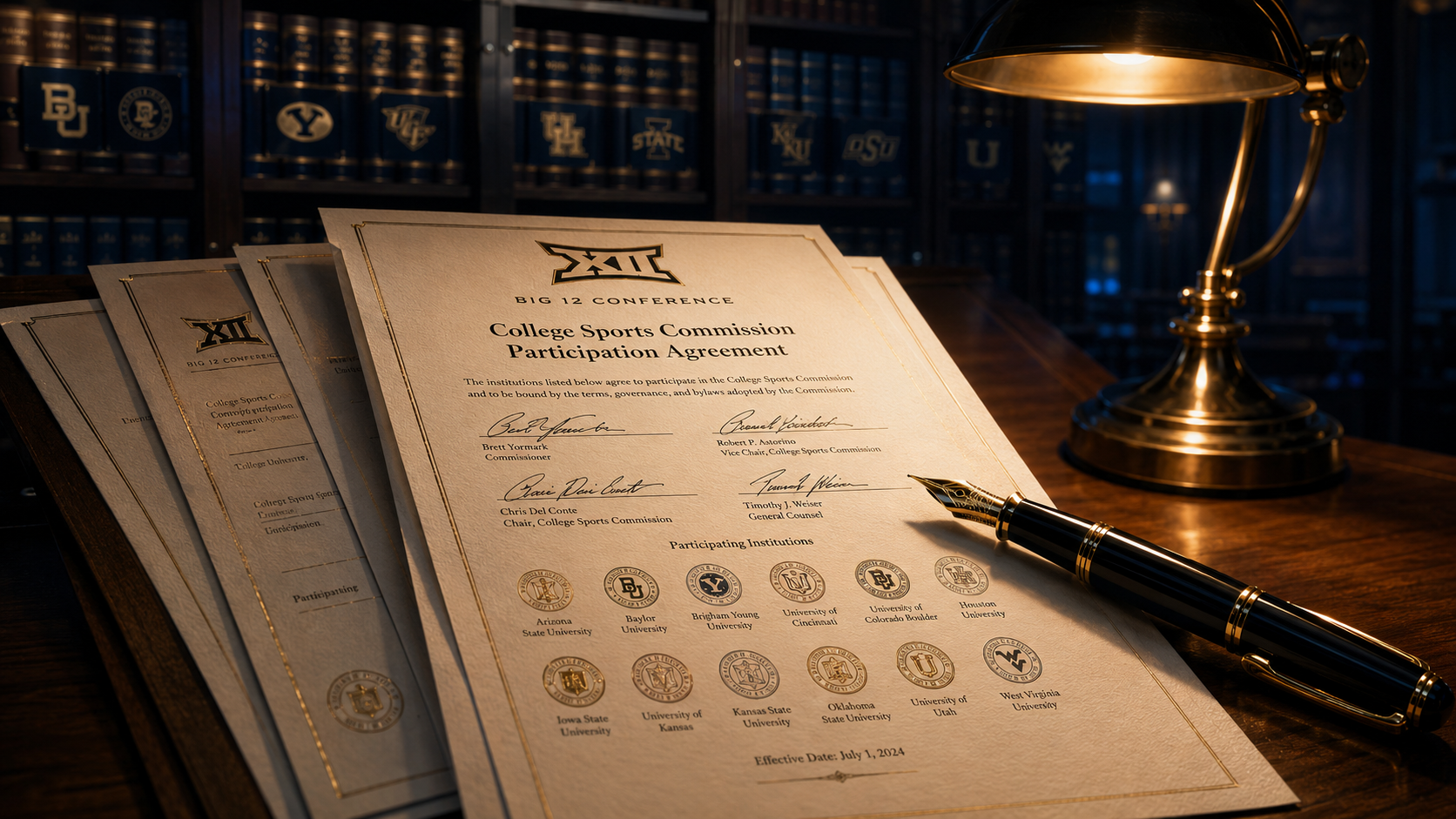
On May 29, after four days of league spring meetings in Frisco, Texas, Big 12 commissioner Brett Yormark confirmed that all 16 member schools would sign the College Sports Commission participation agreement. According to the Associated Press, all signatures are expected by early next week. The Big 12 board of directors, made up of the presidents and chancellors of the league's 16 schools, voted unanimously to back the document.
The College Sports Commission, or CSC, is the agency formed last year under the House settlement to police NIL payments through its NIL Go clearinghouse. The 11-page participation agreement requires schools to waive the right to sue the enforcement agency and gives it wide latitude to sanction programs that violate rules on athlete compensation.
The Big 12 is the first of the four Power Four conferences to deliver every member institution. The agreement only becomes valid when all 68 Power Four schools sign it. The other three conferences have not yet collected every signature.
Why this is more than a procedural step
The headline matters less than what it signals. For nearly a year, programs and conferences have publicly endorsed rules and enforcement while declining to sign the document that would make those rules enforceable on them. The Big 12 is the first conference to align word and signature.
That changes what a Big 12 offer is, in a small but real way. Under the participation agreement, deals at a member school go through the same NIL Go review applied in the May 11 Nebraska arbitration ruling and the same range-of-compensation test that arbitrator applied. Programs in non-signatory conferences operate without that same uniform layer for now.
The CSC has cleared more than 26,000 deals worth roughly $242.3 million through May 1 since its launch. The enforcement model is real, even if its scope is still contested.
What this means for a family reading an offer
For a family receiving an offer from a Big 12 program in the 2027 cycle, three things change.
First, the conference an offer comes from now carries new weight. Programs in a conference that has signed the participation agreement operate under one shared review process. Programs in a conference that has not yet collected every signature do not. That is neither good nor bad on its own. It is a fact to register.
Second, the more enforcement matures, the more the structure of an offer matters. A deal that survives CSC review tends to look different from one that does not. Conferences signing the agreement extend the same structural review across more programs, and the agreement removes a school's option to sue the enforcement body once a ruling lands.
Third, a June 10 hearing in California's Northern District is expected to weigh whether the CSC's definition of "associated entities" stands. That ruling could expand or narrow what NIL Go reviews. A family does not need to track the case. They do need to understand that the rules being read today are not the rules that will be read in three months.
The advisory takeaway is simple. The phrase "Power Four" is no longer a single category. As of this week, one conference inside that grouping is operating under enforced NIL review. The other three have not yet matched it.