

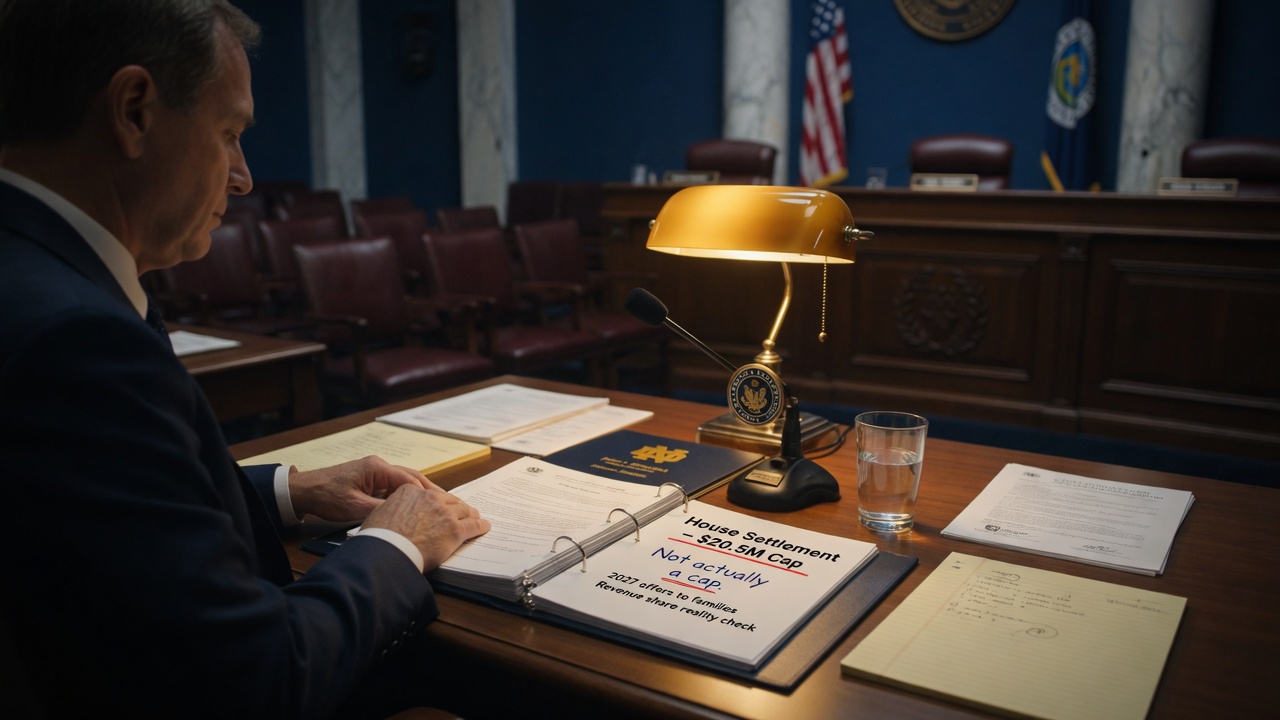
What an athletic director told the Senate
On Wednesday, June 3, 2026, Notre Dame athletic director Pete Bevacqua testified before the Senate Commerce Committee at a hearing on the Protect College Sports Act. He addressed whether the House settlement's $20.5 million revenue-share cap actually functions as a ceiling on program spending. His answer was direct. There is no cap, he said.
The framing he offered the committee was an equation. The $20.5 million revenue-share figure is one variable. Third-party NIL collectives are a separate variable. The sum of the two is the actual roster spend. He called the existing cap number too low and proposed a higher cap paired with a redistribution mechanism for spending above it.
Former Alabama coach Nick Saban offered the supporting data at the same hearing. He traced Alabama's NIL collective spending from $2.7 million in his first year to $24 million in the most recent year. According to ESPN's reporting, some programs are now approaching $40 million in annual roster costs. That figure is roughly double the House settlement ceiling.
Why the gap matters
The House settlement created a number families now see in nearly every NIL story. That number, $20.5 million per school, is real. It governs direct revenue-share payments from the institution. It does not govern total athlete compensation at a program.
Outside the cap, third-party collectives continue to operate. The College Sports Commission's clearinghouse reviews collective deals for valid business purpose and fair-market value, and as the Nebraska arbitration last month showed, the clearinghouse can reject deals it considers disguised pay-for-play. The structural reality Bevacqua described is that programs are still finding ways to stack revenue-share payments with collective NIL deals. The total is materially higher than the headline cap suggests.
For a family looking at a 2027 offer, this is the most useful thing to internalize this week. The cap in the headlines is not the cap on what a program can spend.
How a family should read an offer right now
A modern offer to a 2027 recruit typically has two components, sometimes three. Read each separately.
- The revenue-share component, paid directly by the school, is governed by the House settlement and the program's allocation choices.
- The collective NIL component, paid by a third-party collective, is subject to clearinghouse review and the risk that a deal is rejected after the fact.
- The third-party deal component, paid by an outside business for legitimate NIL use, is the cleanest layer but also the least predictable.
The total number a family is quoted is not a single contract. It is a stack. A program offering at the high end of the stack is not violating a cap that does not exist in practice. The durability of each layer is different, and the program's ability to honor each layer depends on different rules.
Bevacqua's testimony does not change any of those rules. What it does is confirm, on the record, that the cap families read about is one input in a larger equation. A 2027 offer is best read against the full equation, not against the headline number.