

What was released
The College Sports Commission — the body established in 2025 to oversee NIL payments — published its first comprehensive dataset on college football player compensation last week. It is the first time position-by-position figures, combining revenue sharing and third-party NIL, have been released for the sport.
The dataset covers the 2025-26 academic year and includes median and 90th-percentile totals by position, separated by program tier.
The tier gap in numbers
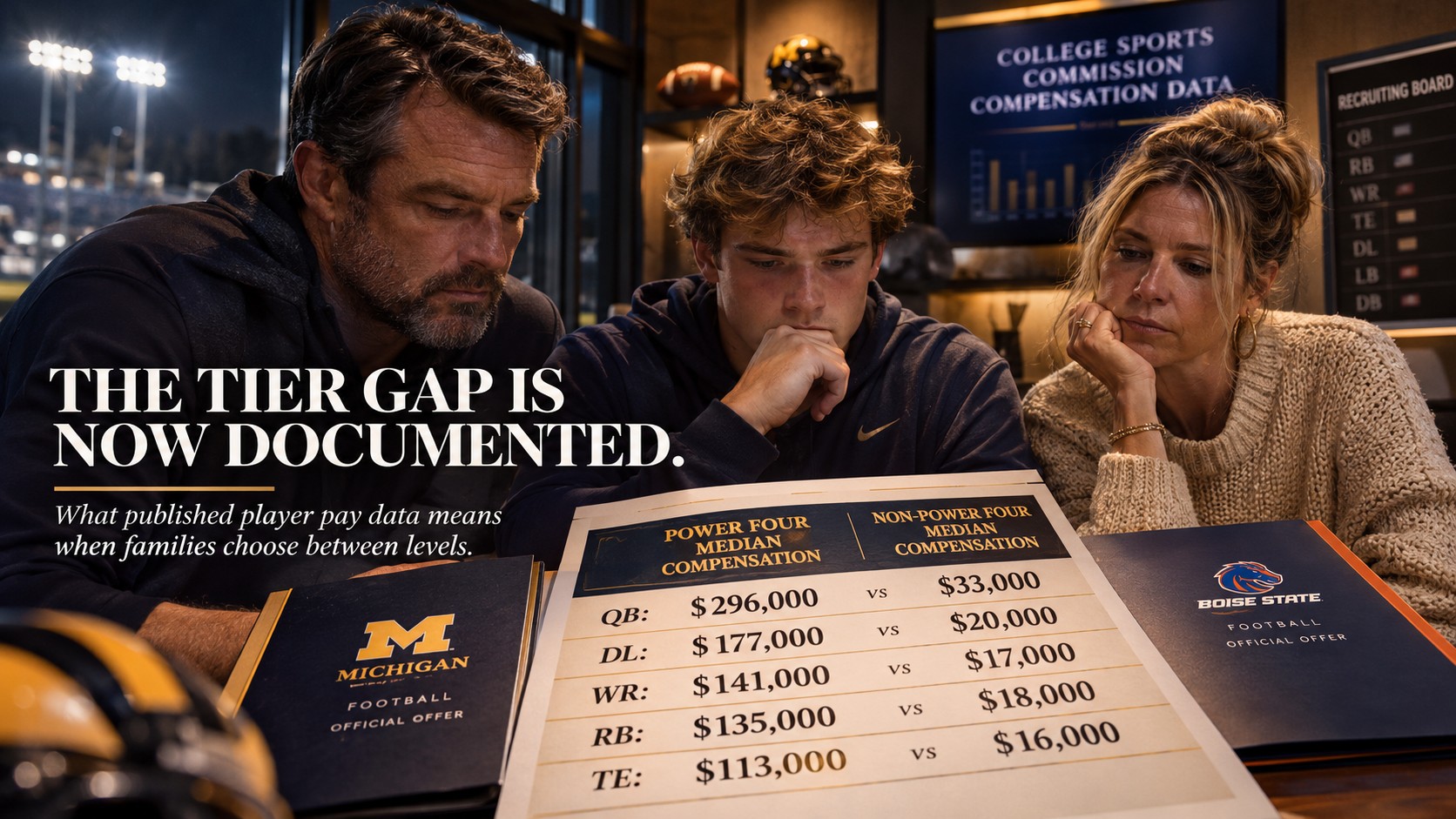
For Power Four programs, median total compensation by position:
- Quarterback: $296,000
- Defensive lineman: $177,000
- Wide receiver: $141,000
- Running back: $135,000
- Tight end: $113,000
For non-Power Four programs — which the dataset groups as Group of Five and FCS together — the figures were substantially lower:
- Quarterback: $33,000
- Defensive lineman: $20,000
- Running back: $18,000
- Wide receiver: $17,000
- Tight end: $16,000
The gap at the quarterback median is roughly nine times. Across other positions the multiple runs in a similar range.
What this means for families weighing offers
Families evaluating a Group of Five offer while waiting on Power Four conversations have always understood there was a financial difference between tiers. The CSC data provides, for the first time, a documented baseline for that gap.
A few things worth understanding before using these figures:
These are year-one figures. Revenue sharing launched in 2025-26 with a cap of $20.5 million. The cap rises roughly 4% annually. Median pay in future cycles will likely be higher.
Medians describe a distribution, not a guarantee. The 90th-percentile figure for Power Four quarterbacks was $2.6 million — the same position that earns $296,000 at the median. The range is wide. What a specific athlete is offered depends on the program and the player.
Rev-share and NIL combine differently by tier. At Power Four programs, revenue sharing accounted for 30 to 40 percent of the highest earners' total compensation, with third-party NIL making up the rest. At non-Power Four programs, both numbers are significantly smaller.
The dataset has limits. The CSC notes the figures may not capture the full market, and conference-level breakdowns were not released.
How to use this in a family conversation
This data is not a recruiting pitch. A program's tier median does not tell a family what a specific athlete will earn, and no advisor should suggest it does.
What the data provides is a clearer baseline for a question families are already asking: what does the difference between a confirmed Group of Five offer and an ongoing Power Four conversation actually mean in practice?
For families of quarterbacks — where the tier gap is steepest and the spread within the Power Four is widest — that context matters most when programs at different levels are recruiting the same athlete at the same time.
For every position, the main point is the same: the gap is now documented. Families can bring that context into program-fit decisions with more concrete grounding than the category has had before.