

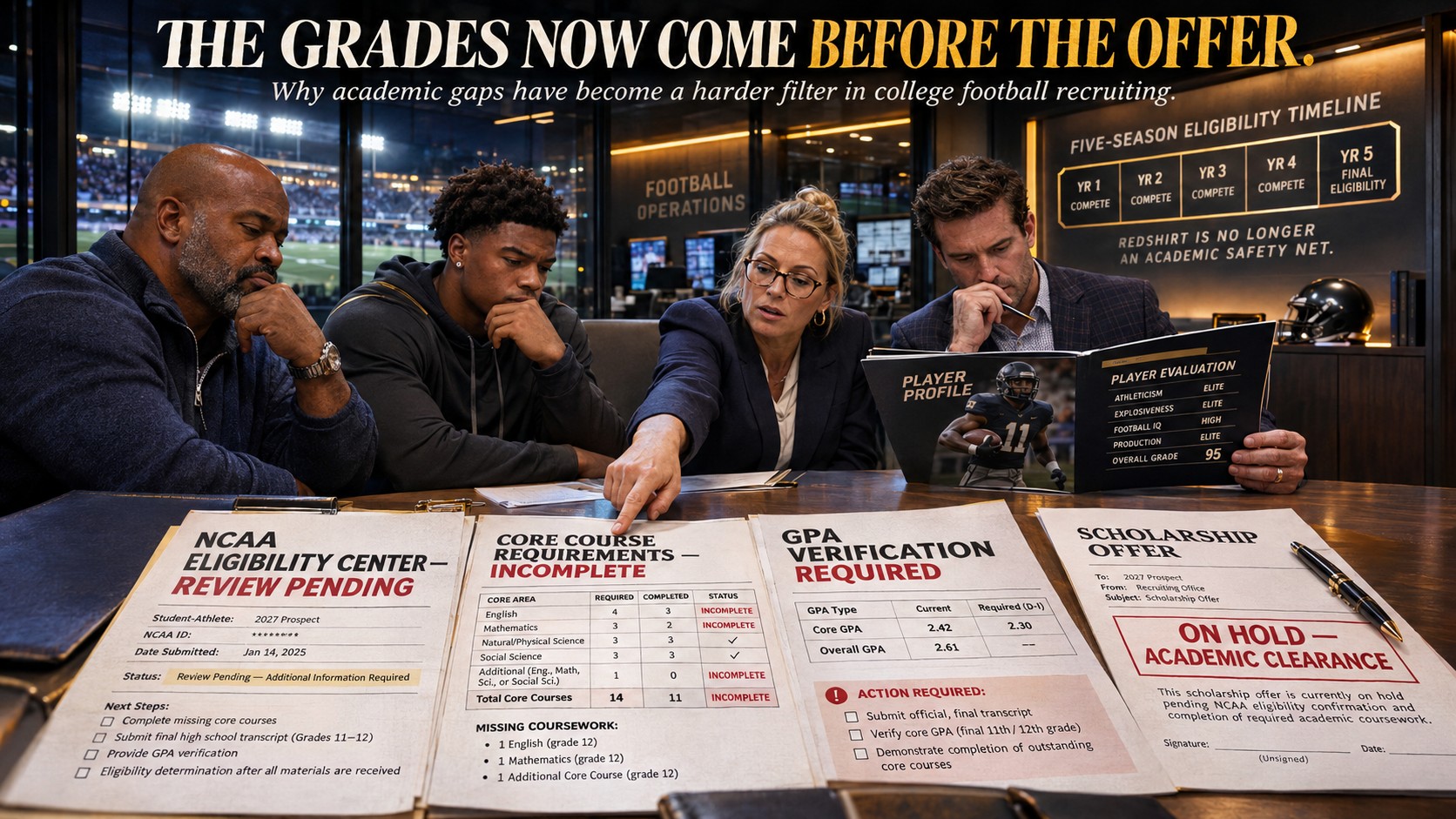
A change in how eligibility is structured
Under the previous NCAA model, a college football program could offer a scholarship to a prospect with an academic gap, enroll that athlete in the fall, and have him sit out year one as a voluntary redshirt. That year gave the athlete time to get his academic footing without burning a season of eligibility. Coaches used this buffer regularly, and families rarely needed to worry about it.
The new five-season eligibility framework has closed that gap. With athletes now expected to compete across a five-year window from the start of their enrollment, using year one as a voluntary sit-out year costs the athlete a competitive season rather than preserving one. The old four-seasons-across-five-years structure built in a free year. The new model does not.
What it means for how coaches evaluate recruits
The practical result is that coaches have lost the bridge they once used for borderline academic cases. When a staff evaluates a prospect with an academic question (a low GPA, incomplete core coursework, or a clearinghouse file that is not straightforward), the safety valve is no longer there.
That changes what happens during the evaluation phase. Coaches who previously might have offered and managed an academic issue after enrollment are now more likely to hold the offer until the academic picture is clearer. The academic piece has moved earlier in the screening process, not later.
For families with athletes who have academic gaps, this is the cycle where those gaps are most likely to surface as a recruiting obstacle before an offer arrives, rather than as a problem to be resolved after one does.
What families should do now
Academic readiness was always a factor in recruiting. The new framework makes it a harder threshold, not just a background consideration.
For families in active recruiting conversations, it is worth understanding where the athlete stands on the following:
- NCAA Eligibility Center registration and academic history
- Core course completion relative to what target programs require
- GPA standing relative to the NCAA sliding scale
- Test score status, if applicable to the athlete's target programs
A coach who is genuinely interested but sees an unresolved academic question is more likely to pause on the offer now than he would have been in prior cycles. Getting clarity on where the athlete stands academically, and being prepared to communicate that clearly to programs showing interest, is a meaningful step families can take in the remaining weeks of this evaluation period.